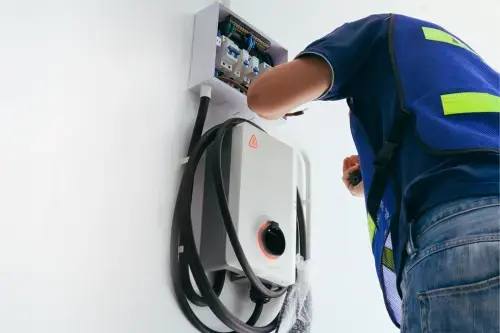
Most people open their electrical panel twice a decade, both times to reset a breaker in the dark. It sits in a basement or garage doing the least glamorous work in the house, which is why damage there goes unnoticed until something smells wrong.
That makes it different from a bad outlet or a dead switch. Every circuit runs through this one box, so a problem inside it reaches everything. Some panel damage is a parts job, and the electricians at Zimmerman Electric Indy fix plenty of them in an hour. Other panels are past saving, and no honest electrician will pretend otherwise. What follows is how that call actually gets made.
Common Signs of Electrical Panel Damage
Panels rarely fail all at once. They warn you first, and the warnings are easy to miss.
- Breakers that trip during normal use. One trip after plugging in a space heater is the breaker working. The same breaker tripping weekly is not.
- A burning smell near the panel. Hot plastic, scorched insulation, anything like that.
- Buzzing, humming, or crackling from inside the box.
- Rust streaks, water staining, or corrosion on the enclosure.
- Lights that dim every time the furnace or refrigerator starts.
- A panel door or breaker that feels warm.
The burning smell is the one that changes your afternoon. Shut off the main breaker and call an electrician. Do not open the cover, do not wait to see whether it clears up. Overheating inside a panel is how wall cavities catch fire, and by the time you smell it, the temperature in there has been climbing for a while.
Rust deserves a mention too, since Indianapolis basements flood more often than people admit. Surface rust on the door is cosmetic. Corrosion reaching the bus bars is not.
When Can an Electrical Panel Be Repaired?
Plenty of panel problems are component problems, and swapping a component costs a fraction of a replacement.
- A single failed breaker that no longer trips or resets correctly
- Loose lugs or terminals that need cleaning and retorquing
- A damaged cover, missing knockout fillers, or a broken dead front
- Adding a subpanel for circuit space without touching the main service
- Replacing a corroded grounding connection
Repair makes sense when the panel underneath is sound. That means a manufacturer still in business, roughly twenty years old or less, clean bus bars, a dry enclosure, and breakers you can still buy.
Age alone does not condemn a panel, incidentally. A well installed thirty year old Square D in a dry utility room can be in better shape than something half its age sitting in a damp crawlspace.
One caution. A breaker that keeps tripping usually gets blamed on the breaker, and sometimes that is right. Sometimes the breaker is fine and the circuit behind it is overloaded, so the new part solves nothing and the real problem stays. Assessment comes before parts, not after.
When Does an Electrical Panel Need Replacement?
Some conditions take repair off the table entirely.
Fuse boxes. If your home still runs on fuses, you are on technology from the middle of the last century. Fuses cannot be reset, which pushes homeowners toward oversized replacements that remove the protection altogether.
Known defective brands. Federal Pacific Stab-Lok panels and Zinsco panels, sometimes labeled GTE-Sylvania, have documented histories of breakers failing to trip under overload. A breaker that will not trip is no longer a safety device. Insurers know this, and some refuse to cover homes with these panels or require replacement first. Check the label inside your panel door.
Burned or pitted bus bars. The bus bar is the panel. Once arcing has damaged it there is nothing to repair, because the damaged part is the structure everything else clips into.
Parts you cannot buy. Pushmatic and other discontinued lines work fine until a breaker fails, and then the search begins. Salvaged breakers from an unknown source are not a fix.
Capacity that ran out years ago. A 60 or 100 amp service was reasonable when the house had a window air conditioner and two televisions. Add a heat pump, a finished basement, and an EV charger, and the arithmetic stops working.
Factors That Determine Repair vs. Replacement
Electricians weigh a handful of things, and the answer shifts depending on which one matters most in your situation.
- Age and condition. Twenty five years is a rough dividing line, though condition beats the calendar.
- What caused the damage. A lightning surge is a different problem from years of running at capacity.
- Your plans. An EV charger, a hot tub, or a basement remodel changes things, since a repaired panel with no open slots gets you nowhere.
- The money, honestly compared.
That last one is where people talk themselves into the wrong choice. Panel replacement in Indianapolis generally runs $2,500 to $3,000, with a full service upgrade to 200 amps including meter and riser closer to $4,200. Permits add roughly $75 to $250. Reference numbers, not quotes, since the real figure depends on your service, panel location, and what the installation looks like once the cover comes off.
Spending $600 on repairs today and $2,800 on replacement in two years is worse math than replacing once. Not always. But often enough to deserve an honest conversation before anybody orders parts.
Why Professional Electrical Assessment Is Important
Everything that matters here sits behind a cover most homeowners should never remove. The conductors feeding your panel stay energized even with the main breaker off, which is the part people underestimate.
An assessment finds what a glance cannot:
- Heat damage and discoloration on bus bars and lugs
- Double tapped breakers, where two wires share a terminal built for one
- Undersized or improperly bonded grounding
- Circuits that need AFCI or GFCI protection under current code
- Measured load, rather than a guess about capacity
There is a paperwork side too. Panel work needs a permit in Marion County and surrounding jurisdictions, and unpermitted work resurfaces during a home sale or an insurance claim. Zimmerman Electric Indy handles DBNS permitting, coordinates with AES Indiana when the service itself changes, and schedules the inspection.
The assessment is free and comes with a written estimate. Finding out what you have is cheaper than guessing wrong.
FAQs
How do I know if my electrical panel is damaged?
Look for scorch marks, rust, corrosion, or melted insulation around the breakers. Listen for buzzing. Notice whether breakers trip during ordinary use or lights dim when large appliances start. Any burning smell means shutting off the main and calling an electrician right away.
Can a tripped breaker mean my electrical panel needs replacement?
Usually not. Occasional tripping is the breaker protecting the circuit. Repeated tripping on one circuit points to an overload, a failing breaker, or a panel past its capacity. Telling them apart takes measurement, not guesswork.
How much does it cost to repair or replace an electrical panel?
A single breaker is modest. Full replacement in Indianapolis typically falls between $2,500 and $3,000, and a 200 amp service upgrade with meter and riser runs closer to $4,200. Permits add $75 to $250. Get a written estimate before agreeing to anything.
How long does an electrical panel typically last?
Between 25 and 40 years for a good panel in a dry location. Moisture, corrosion, and years of running near capacity shorten that. Defective brands like Federal Pacific and Zinsco should be replaced regardless of age.
How long does an electrical panel typically last?
Between 25 and 40 years for a good panel in a dry location. Moisture, corrosion, and years of running near capacity shorten that. Defective brands like Federal Pacific and Zinsco should be replaced regardless of age.
Should I replace an old electrical panel before selling my home?
Often yes. Home inspectors flag outdated panels, and a Federal Pacific or Zinsco panel gives buyers room to negotiate or scares off their lender. Replacing beforehand removes the objection and gives you paperwork to hand over at closing.
